

Which Is Best at What?
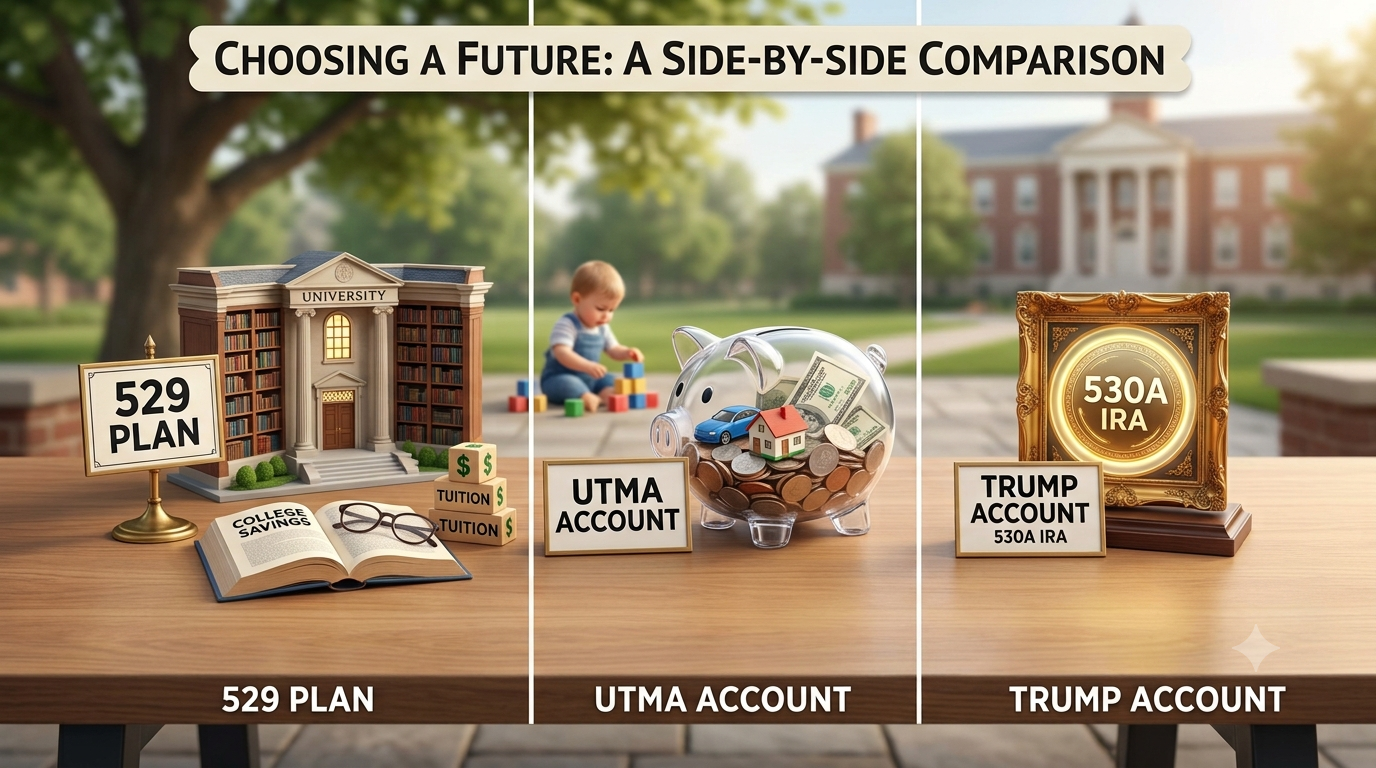
Image created using AI by Google Gemini

Key Takeaways
When parents and grandparents begin saving for a child’s future, one of the first questions they face is which account to use. Over the years, 529 plans and UTMA accounts have been among the most common options available. More recently, Trump Accounts have been introduced as another tool families may consider when building long-term wealth for children.
Each account comes with its own strengths, limitations, and tax advantages. Importantly, these accounts are not necessarily competing solutions. In many situations, the most effective strategy may involve using multiple account types together, with each serving a different purpose within a comprehensive financial plan.
Trump Accounts: The Head Start on Retirement Savings
Trump Accounts were designed to help children begin building long-term wealth. Like a Traditional IRA, assets generally grow tax-deferred, but unlike a Traditional IRA, contributions may be made even if the child has no earned income. The account converts to a Traditional IRA when the child turns 18.
Benefits of a Trump Account
One of the most attractive features of a Trump Account is the ability to begin investing for a child immediately after birth, even if they have no earned income. For families focused on long-term wealth accumulation, this creates an opportunity for decades of tax-deferred growth and may be particularly attractive for grandparents interested in multi-generational planning.
Perhaps the most discussed planning opportunity involves the possibility of a future Roth conversion. Beginning in the year the child turns 18, the account generally becomes subject to traditional IRA rules, which may allow for Roth IRA conversions.
For example, assume a child accumulates a $100,000 Trump Account balance by age 18 and converts that balance to a Roth IRA. If those assets earn an average annual return of 7% and remain invested until age 60, that account could potentially grow to approximately $1.7 million. If Roth IRA distribution requirements are satisfied under current tax law, qualified withdrawals generally are federal income tax-free.
A Roth conversion may be especially attractive at age 18 because many young adults have little or no earned income and are in a very low tax bracket. Paying taxes on a relatively modest balance early in life may allow decades of future tax-free growth. Put differently, many families would likely rather pay taxes on $100,000 at age 18 than on a potentially much larger balance decades from now.
Potential drawbacks
The primary drawback of a Trump Account is that, similarly to Traditional IRAs, there is a 10% early withdrawal penalty for distributions taken before age 59.5, notwithstanding a small list of exclusions.
Trump Accounts are also generally not as tax efficient as a 529 plan when the primary objective is education funding. Unlike qualified 529 distributions, withdrawals do not typically receive same favorable federal tax treatment when used for education expenses.
Families should also recognize that withdrawals may be taxable and that investment options may be more limited than those available in a traditional brokerage account or UTMAs.
529 Plans: The Education Funding Specialist
For families whose primary objective is saving for education, the 529 plan remains one of the most powerful planning tools available. 529 plans are specifically designed to encourage education savings through favorable tax treatment. Contributions grow tax-deferred, and earnings are generally free from federal income tax when withdrawn for qualified education expenses.
Benefits of a 529 plan
The greatest advantage of a 529 plan is its tax efficiency when used for qualifying educational expenses.
For families who expect college to be a significant future expense, few accounts can match the tax benefits available through a properly funded 529 plan, as the ability to avoid taxation on investment growth can be significant over time. Many states also provide state income tax deductions or credits for contributions, creating an additional potential benefit.
Parents also retain substantial control over the account and can often change beneficiaries if circumstances change.
Potential drawbacks
The primary limitation of a 529 plan is that it is designed specifically for education-related purposes.
Although recent legislative changes have added flexibility such as the 529-to-Roth conversion opportunity, families may still face taxes and penalties on earnings if funds are withdrawn for non-qualified purposes.
For families uncertain whether their child will pursue higher education, this reduced flexibility can be a concern.
UTMA Accounts: The Most Flexible
A UTMA account differs from both Trump Accounts and 529 plans because it places very few restrictions on how funds can ultimately be used. Rather than being designated for education or retirement-oriented purposes, UTMA assets generally belong to the child and may be used for virtually any purpose that benefits them.
Benefits of a UTMA account
The greatest advantage of a UTMA is flexibility. Funds may ultimately help pay for a first car or home purchase, starting a business, graduate school, professional training, travel opportunities, or any number of future life goals.
Investment options are also generally broader than those available within Trump Accounts. For families unsure what path their child may pursue, a UTMA can provide flexibility that other accounts cannot.
Potential drawbacks
The tradeoff for flexibility is reduced tax efficiency. Unlike 529 plans and Trump Accounts, UTMAs generally do not provide tax-free or tax-deferred growth.
In addition, once the child reaches the applicable age of majority, the assets legally become theirs to control. The child may ultimately use the assets in ways the parents would not have chosen, and the parents generally no longer have the authority to restrict those decisions.
How These Accounts Can Work Together
One of the biggest misconceptions in child-focused planning is that families must select only one account. In many cases, a more comprehensive approach is to assign a different role to each account.
- A 529 plan can serve as the education-specific bucket
- A UTMA can serve as the flexibility bucket
- A Trump Account can serve as the long-term wealth and retirement bucket
For example, a family saving $12,000 per child annually might allocate:
- $6,000 to a 529 plan for future education expenses
- $3,000 to a UTMA for future opportunities
- $3,000 to a Trump Account for long-term retirement wealth
In this scenario, each account serves a distinct purpose while helping balance flexibility, tax efficiency, and long-term wealth accumulation. Rather than asking which account is best, families may benefit from reviewing their priorities and considering which account is best suited for their specific goals.
| Feature | Trump Account | 529 | UTMA |
| Primary Goal | Retirement savings | Education savings | Flexibility for wide range of goals |
| Tax Growth | Tax-deferred until withdrawal | Tax-deferred growth; qualified withdrawals are generally federal income tax-free | Taxable annually on any dividends, interest, and realized gains |
| Ownership and Control | Child assumes ownership and control at age 18 | Account owner retains control | Child assumes control at age of majority in their state |
| Potential Drawbacks | Penalties for early withdrawals before age 59.5, not as tax efficient when used for education expenses | Reduced flexibility if funds aren’t used for education | Eventual loss of parental control, taxation can happen in current year instead of tax deferral |
| Best For | Long-term wealth building | College and graduate school savings | Future car purchase, first home down payment, entrepreneurship opportunities, and more |
Key Takeaways and Considerations
- Trump Accounts, 529 plans, and UTMAs each serve different purposes
- A 529 plan is generally the most tax-efficient option for education funding
- UTMAs offer the greatest flexibility but provide fewer tax advantages
- Trump Accounts may offer compelling long-term wealth accumulation opportunities and potential future Roth conversion planning
- Many families may benefit from using multiple account types simultaneously
- The most effective strategy often aligns each account with a specific financial objective rather than relying on a single account for every goal
Summary
There is no universally “best” account. The right solution depends on a family’s goals, priorities, and timeline. Understanding how these accounts complement one another can help create a flexible, tax-efficient, and comprehensive strategy for supporting a child’s future.
Good financial planning isn’t a “one size fits all” experience. If you’re thinking about how this applies to your own situation, you’re already at the point where having a conversation makes sense. That’s where partnering with our practice begins:
This article is for educational purposes only, and individuals should consult qualified legal and tax professionals regarding their specific circumstances. Clearfront Advisory does not provide legal or tax advice. Tax laws are subject to change, and the availability of certain tax benefits depends on individual circumstances. Consult your tax advisor regarding your specific situation.
This post was researched and written by the author with the assistance of AI writing tools. All content reflects the author’s own views, has been independently verified, and has been reviewed and approved prior to publication.
Section 529 Plans: The fees, expenses, and features of 529 plans can vary from state to state. 529 plans involve investment risk, including the possible loss of funds. There is no guarantee that an education-funding goal will be met. In order to be federally tax free, earnings must be used to pay for qualified education expenses. The earnings portion of a nonqualified withdrawal will be subject to ordinary income tax at the recipient’s marginal rate and subject to a 10 percent penalty. By investing in a plan outside your state of residence, you may lose any state tax benefits. 529 plans are subject to enrollment, maintenance, and administration/management fees and expenses.
The examples presented use hypothetical portfolio models with a hypothetical 7% return and are provided for illustrative purposes only. No specific investments were used in this scenario, and actual results may vary based on a variety of factors, including changes in market conditions, portfolio selections, and economic circumstances. Past performance is not indicative of future results, and future returns are not guaranteed. These projections are based on assumptions which may not be realized, and this scenario does not account for taxes, fees, or other potential expenses which may affect outcomes. Investors should not rely solely on this information when making an investment decision. Please consult your financial professional for advice tailored to your individual situation.