

Building Wealth for The Next Generation
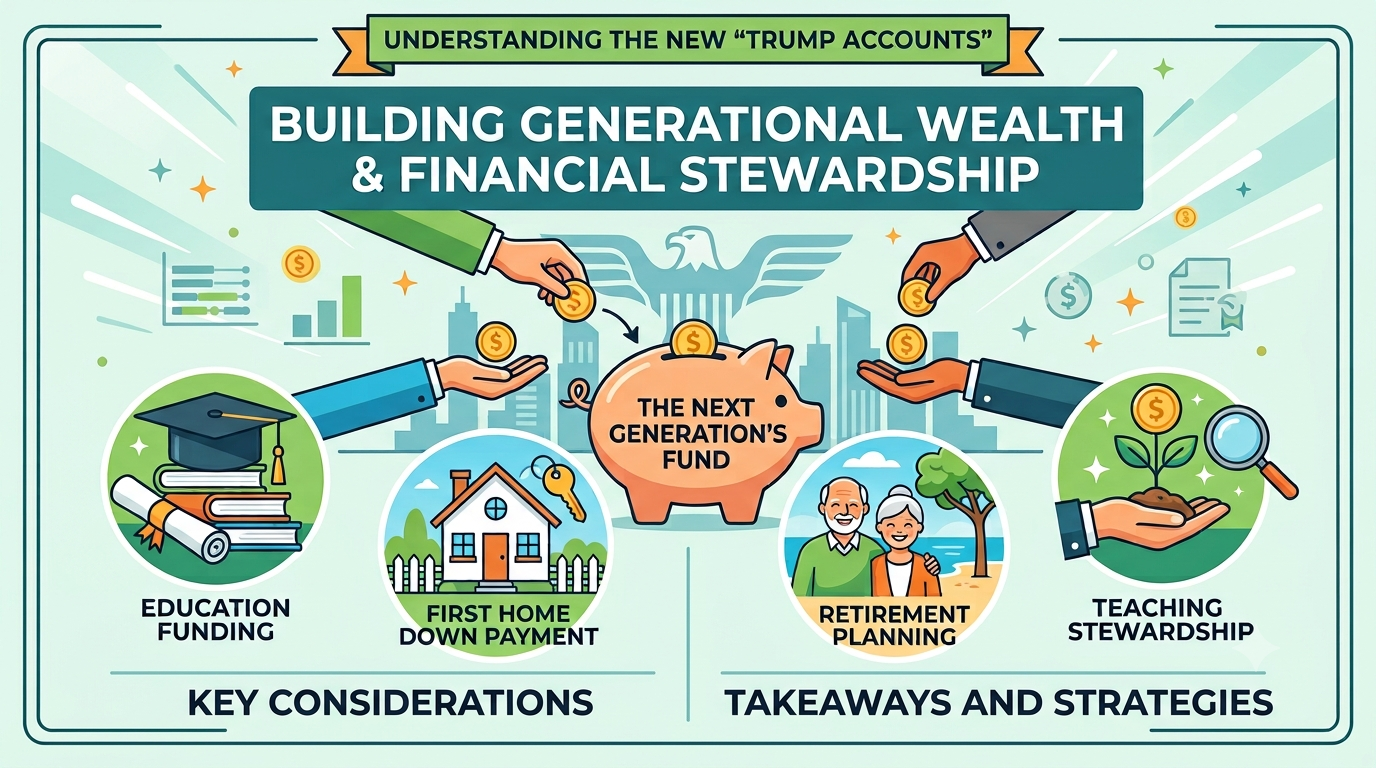
Image created using AI by Google Gemini

Key Takeaways
- “Trump Accounts” are designed to give children a long runway for tax-advantaged growth, making time the primary driver of potential wealth creation
- Early and consistent contributions can compound into meaningful account balances by age 18, and even more so if left untouched into adulthood
- The real opportunity isn’t just saving— it’s intentional, multi-decade planning tied to family goals like education, homeownership, and retirement
Lots of wealth strategies focus on what specific investments to own, but this strategy focuses more on when you start saving. With a long enough time horizon, the specific vehicle matters less than the discipline behind it. A child who has even modest contributions invested from an early age has the chance to benefit from something many adults struggle replicate: decades of uninterrupted compounding.
This is where Trump Accounts fit in. At their core, they’re less about short-term tax savings and more about building a financial foundation early enough that time becomes the primary engine of growth. The strategic question isn’t just how much to contribute, but what the account can do for your child over time.
A Hypothetical Example of Investment Compounding
To see how this works in practice, consider a simple, intentional approach: A family who contributes $5,000 annually into a Trump Account starting at birth and invests in a diversified stock portfolio. Assuming a 7% annual investment return, the account could grow to roughly $170,000 by age 18– $90,000 of which represents contributions into the account and $80,000 of which represents investment growth.
If the funds remain invested into adulthood, that balance could exceed $750,000 by their early 40s, without additional contributions after age 18. That’s the power of starting early and letting compounding work over decades.
Use Case #1: Education Funding (Complimenting a 529 Plan)
Trump Accounts can play a valuable role alongside traditional education savings strategies. A 529 plan remains the most tax-efficient vehicle for qualified education expenses like tuition, fees, and certain room and board costs. From a planning standpoint, it makes sense to fully utilize the 529 for those clearly defined, tax-advantaged uses, while positioning a Trump Account as a supplemental pool of money for the broader financial realities that come with the college years.
Where this pairing becomes especially valuable is with the types of expenses that fall outside 529 rules but are still very real for students. Things like buying a car, furnishing an off-campus apartment, covering travel or spending money while studying abroad, or handling unexpected life costs don’t qualify for 529 distributions without tax or penalty. Having a separate, flexible account allows families to meet those needs without disrupting the tax efficiency of the 529. In practice, it can create a cleaner system: the 529 handles the educational expenses that it’s designed for, while the Trump Account fills in the unknown gaps that may show up along the way.
Use Case #2: First Home Down Payment
One of the biggest financial hurdles for younger generations these days is accumulating a meaningful sum of money for a down payment on a house. A well-funded Trump Account can serve as a launching pad into homeownership, particularly as the account continues to grow beyond the contribution years. By the time a child reaches their mid-to-late 20s, the account may represent a meaningful source of liquidity at a point when income is still ramping up and savings capacity is limited.
There’s also a subtle but important shift in how families approach this milestone. Instead of providing financial support reactively, often at the exact moment a purchase opportunity arises, this approach builds independence into the plan itself. The child enters adulthood with pre-positioned capital that has been compounding over time, allowing them to act more decisively and with greater flexibility. In practice, this can influence not just whether they can buy a home, but when, where, and under what financial terms.
Use Case #3: A Head Start on Retirement
Ironically, the most powerful use of the account may be the one that will end up getting used the least. If a portion of the account remains invested into adulthood, the child effectively begins their retirement savings decades ahead of schedule, with compounding doing most of the heavy lifting. This can reduce the need for aggressive savings later in life and meaningfully shift long-term financial outcomes. Returning to the earlier example of a family contributing $5,000 per year for 18 years and earning a 7% annual rate of return, if the account is left untouched until the child’s age 65, the balance could grow to over $4,000,000 from just $90,000 of original contributions into the account.
What makes this especially compelling is how difficult it is to replicate later. Dollars invested early have a disproportionate impact compared to those invested in peak earning years closer towards their target retirement date. Even preserving just a part of the account for long-term retirement savings can create a foundational layer of savings that future contributions simply build on. From a planning standpoint, this introduces more flexibility around career choices, lifestyle decisions, and even retirement timing in a way that few other strategies can match.
Use Case #4: Teaching Financial Stewardship
There’s a behavioral component to this strategy that often gets overlooked. An opportunity like a Trump Account can be used as a learning tool, helping demonstrate how investing works over time while introducing concepts like volatility, patience, and long-term thinking. Gradually involving a child in the process as they get older allows the account to become more than just a balance, it becomes an invaluable lesson in financial literacy and education.
In some cases, the real risk isn’t that the child won’t have enough, but that they won’t know how to manage what they have. Structuring the account in a way that encourages visibility and discussion helps families introduce financial concepts over time rather than all at once. By the time the child has control or influence over the account, they can develop a framework for decision-making that supports long-term outcomes, turning the transfer of wealth into the transfer of both capital and capability.
Key Considerations and Tradeoffs
- Contribution Strategy: Beginning contributions as early as possible can significantly increase long-term outcomes due to compounding. Dollars invested in the earliest years have the longest runway, making consistency and timing more impactful than trying to maximize contributions in any single year.
- Investment Approach: Trump Accounts are limited to low-cost, diversified ETFs and mutual funds that track broad U.S. equity indices, such as the S&P 500. While this limits customization, it naturally steers the strategy toward equity-focused investing, which has historically been the primary driver of long-term growth and compounding over multi-decade periods.
- Coordination With Other Vehicles: These accounts can become even more effective when integrated alongside 529 plans, UTMA accounts, and eventually Roth IRAs. Each vehicle can serve a distinct role –whether that’s education funding, flexible early-life expenses, or long-term retirement savings– creating a more intentional, coordinated strategy.
- Legislative Uncertainty: As a newer concept, the rules, contribution limits, and tax treatment may evolve over time, which introduces an element of uncertainty into long-term planning.
- Opportunity Cost: Dollars allocated to a Trump Account are dollars not being used elsewhere, whether that’s maximizing retirement accounts, paying down debt, or building liquidity. The strategy works best when it complements, rather than replaces, other core financial priorities.
Summary
The real value of a Trump Account isn’t the account itself, it’s the opportunities it can represent: a shift toward long-term, generational planning. When used intentionally, it can help fund key life events, reduce future financial stress, and create a meaningful head start that compounds over decades.
Good financial planning isn’t a “one size fits all” experience. If you’re thinking about how this applies to your own situation, you’re already at the point where having a conversation makes sense. That’s where partnering with our practice begins:
Clearfront Advisory does not provide legal or tax advice. You should consult a legal or tax professional regarding your individual situation.
This post was researched and written by the author with the assistance of AI writing tools. All content reflects the author’s own views, has been independently verified, and has been reviewed and approved prior to publication.
The examples presented use hypothetical portfolio models with a hypothetical 7% return and is provided for illustrative purposes only. No specific investments were used in this scenario, and actual results may vary based on a variety of factors, including changes in market conditions, portfolio selections, and economic circumstances. Past performance is not indicative of future results, and future returns are not guaranteed. These projections are based on assumptions which may not be realized, and this scenario does not account for taxes, fees, or other potential expenses which may affect outcomes. Investors should not rely solely on this information when making an investment decision. Please consult your financial professional for advice tailored to your individual situation.