

A Series on Culture, Discipline, and the Compounding Power of Doing Things the Right Way
3 national championships. 7 Final Fours. 42 NCAA Tournament appearances. “The Perfect Game.” “The Perfect Ending.” 106 years of history.
Welcome to the Villanova Book of Basketball.
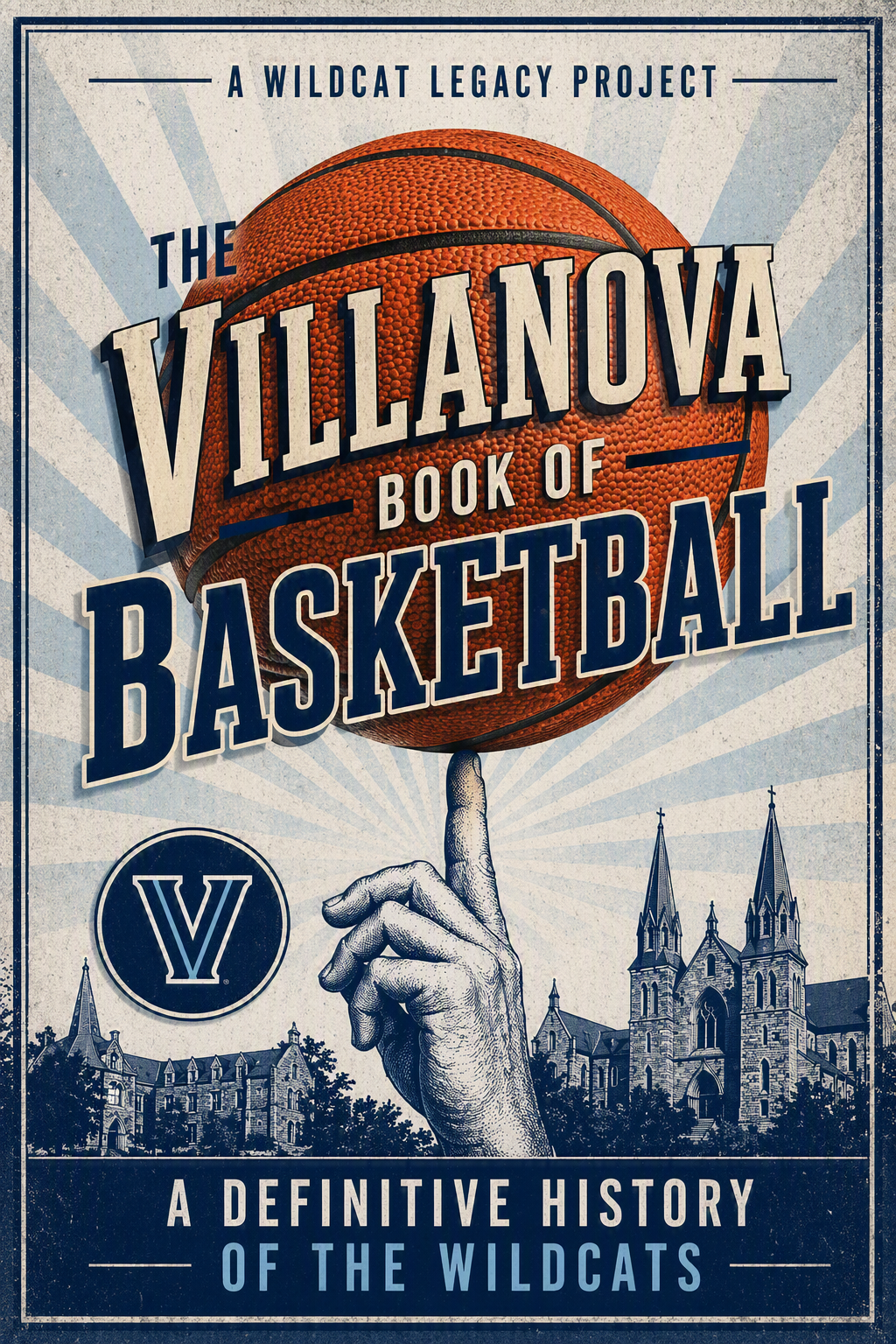
Image generated with AI by Microsoft Copilot
Why a Wealth Advisor Is Writing About Basketball
This is a passion project. I want to be upfront about that.
I am a Villanova guy. I have watched this program through championships and heartbreaks, through dynasties and rebuilding years, through moments that made me jump off my couch and losses that ruined a week. I have also spent my career as a wealth advisor working with business owners, entrepreneurs, and high-achieving families — people who build things, protect things, and eventually hand things off.
At some point those two parts of my life started talking to each other.
The same traits that built Villanova into a Blue Blood program are the ones I see in the clients who get it right. Not talent alone. Not one great year. Culture. Process. The willingness to do the unglamorous work across decades and trust that it compounds. I started writing about it on Twitter. The response told me it deserved more room than 280 characters.
This is that room. If you bleed blue and white, I think you’ll see this program differently by the time we’re done. If you’ve never watched a Nova game in your life but you own a business and care about building something that lasts — I think this series is for you too.
The Practice in the Room
I should tell you something about where this series comes from, because context matters.
I run Clearfront Advisory, an independent wealth management practice based in Dallas. In early 2025, I acquired the Clearfront name and platform from Warren Cohen — a Michigan Man in every sense — who had built the practice as a solo advisor over a long career. My team and client base, which represent the foundation of what Clearfront is today, merged into that structure to create something bigger than either of us had separately. Warren remains with us as Advisor Emeritus, a respected voice winding down a distinguished career the right way. Eli Dorf, our Director of Financial Planning Services and the next generation of this practice, is a UConn guy.
A Villanova guy. A Husky. A Michigan Man.


We discuss basketball seriously, and we are better advisors for it. The conversations aren’t really about basketball — they’re about what makes something great. What separates a program that wins once from one that wins across generations. Whether sustained excellence comes from a singular coach, a system that outlasts any one person, or a culture so deeply embedded it recruits and develops talent almost automatically. Whether the traits that define elite teams — accountability, preparation, adaptability under pressure — can be taught, or whether they have to be lived. Whether you can rebuild greatness after a dynasty ends, and what that process actually requires.
Those are not abstract questions in our practice. We lived a version of this story ourselves — a founder stepping back, a next generation stepping forward, a practice being rebuilt with new energy and a longer horizon. The parallels to what we study in this series are not lost on us. This is where I put them in writing.
What This Series Is — and What It Isn’t
This is not a sports blog that occasionally mentions money. And it is not a financial planning blog that uses basketball as decoration.
Every chapter goes deep on a player, a coach, an era, or a moment from Villanova basketball history. We look at what is actually happening underneath the story — the behavioral psychology, the decision-making, the moments where discipline either held or broke. And then we bring it home. Every chapter ends with a Coach’s Clipboard — a concrete financial action item connected directly to what we just studied.
I mean that bridge requirement seriously. The connection is never decorative. Mental toughness at the free throw line and mental toughness when your portfolio is down 20% are not different skills. They are the same skill tested in different arenas. Villanova has been teaching one version of it for 106 years. I have been on the other side of that conversation with clients for two decades.
This series is where those two things finally meet on paper.
The Arc of the Series
We are going to move through Villanova basketball history the way you’d walk through a family album. Because that’s what it is — a program that passes something down, generation to generation, coach to player to coach again.
We’ll start at the beginning, with Al Severance — the coach who built the foundation that every Villanova era since has stood on. We’ll move through Jack Kraft, who took the program to its first modern Final Four, to Rollie Massimino and the most perfect game ever played in a championship setting. We’ll spend real time in the Jay Wright era, because what Wright built from 2001 to 2022 is one of the greatest sustained culture constructions in the history of college athletics — and it is directly applicable to how you build a business or a portfolio over a 20-year horizon.
And we’ll end — for now — with the present moment. Kyle Neptune’s tenure ended in March 2025. Kevin Willard was announced as head coach days later. The program is at an inflection point. That inflection point is, itself, a financial lesson about what happens after a dynasty ends and what it takes to rebuild.
A Note on Lifelong Learning
One of the things I believe deeply — and try to build into how Clearfront operates — is that the best professionals never stop being students. Not just of their craft. Of everything.
Writing this series is an act of that. I know this history well. I have studied these teams, these coaches, these players for a long time. But writing forces a different kind of thinking than watching or reading does. You have to commit to a point. You have to find the through-line. You have to do the work of connecting the story to something that actually matters.
That’s what I’m asking of myself here, chapter by chapter. It’s also, not coincidentally, what I ask of my clients.
Coach’s Clipboard — Chapter 0
Before you read another word of this series, I want you to do one thing.
Think about the last time a market event — a correction, a headline, a bad quarter — caused you to make a decision you later regretted. Maybe you sold something. Maybe you froze. Maybe you second-guessed a long-term plan because of a short-term number.
Write it down. One sentence. What happened, what you did, and what it cost you.
That moment — that gap between the right decision and the decision you actually made — is what this entire series is about. Villanova basketball has spent 106 years building a culture that narrows that gap. Massimino called it playing a perfect game. Jay Wright called it the Wildcat Minute. Nick Saban called it the Process.
We’re going to learn what it actually means — and how to apply it to the highest-stakes decisions in your financial life.
See you in Chapter 1.
By Kevin Curley II, CFP®, CEPA® | Senior Wealth Advisor, Clearfront Advisory
This post was researched and written by the author with the assistance of AI writing tools. All content reflects the author’s own views, has been independently verified, and has been reviewed and approved prior to publication.